The mental and physical trainer Sigurd Hartvig sees a clear connection between our body contact, use of senses, and the development of stress and fear. Learn more about the function of the senses – and about their maintenance.
When children's and adults' primary senses are persistently understimulated, it can affect health and quality of life. Fortunately, we can do a lot ourselves. If we have problems with the sense of touch, it is often possible to train them away.
"In my work with people with, for example, stress-related disorders, anxiety, or depression, I often hear that they find it difficult to feel themselves, their partner, and their own presence. They describe an experience of having lost balance and grip – indeed, the whole life energy," says motor skills instructor and trainer Sigurd Hartvig, who has a background as a teacher.
– All sensory impressions are necessary for our survival. Through stimulation, play, and movement, our senses develop. Sensory integration occurs when the different impressions are gathered in the brain. The senses are enormously important both for the development and maintenance of the ability to express oneself.
– When we train the senses, we simultaneously exercise our emotions and thoughts.
Many years of experience with rehabilitation have taught him that many people with mental or physical illnesses – all who have been inactive on the sofa or in bed for a long time – have had their senses put on hold.
They need to have them awakened again, and nature is full of opportunities that can be adapted to that need. Therefore, in his work as a mental and physical trainer, he uses nature as a training facility.
Our primary senses are: Tactile, proprioceptive, and vestibular senses.
The sense of touch, also known as the tactile sense, is extremely important. It is crucial for whether we can feel ourselves tactilely – that is, feel ourselves physically and emotionally. It registers cold and heat through small receptors all over the skin as well as psychological and social contact with others. It is our largest sense, and it resides in the skin and mucous membranes. It has significant importance for reflexes, movements, balance, and emotional life," he explains.
The sense of touch can be divided into two:
"The purpose of the muscle-joint sense is, among other things, to ensure that the body constantly knows how movements occur throughout the body. This happens via small sensors in the muscles, joints, and tendons. The sense affects movement, body awareness, space, sense of direction, and tonus, which is the tension in muscles and tissue.
The muscle-joint sense communicates with the brain about where the muscles are located, so the brain can adjust and regulate the movement accordingly. The sense provides feedback on movements. And movements initiate the sensation of the position and movement of body parts – also called the kinaesthetic sense," explains the trainer.
Sigurd Hartvig has previously worked with neglected children.
"Children who are understimulated because the parents have been unable to take care of them, and who have not been breastfed, received loving touches, or received natural stimulation like being rocked back and forth, often have problems with the labyrinth sense. Because they have not been sufficiently stimulated, some of them, for example, nearly fall asleep when they have to go out for a walk. Others are hyperactive and dizzy," says Sigurd Hartvig.
The labyrinth sense is also called the vestibular sense. It controls, among other things, our eye movements, so we see steadily.
"The labyrinth sense is a sensory apparatus located inside the ear, ensuring that we can maintain balance. It detects the movement of the head – from here, messages are sent to the brain about the head's rotational movements, direction, and speed.
"The psyche is greatly affected by the labyrinth sense. Being able to maintain one's balance influences it. One feels secure when equilibrium is in order – and has a clear sense of where one is. Conversely, one will become insecure and nervous if balance is not maintained. An uncertain body gives an uncertain feeling towards physical challenges, but especially towards psychological ones. With poor coordination and balance, one will always feel insecure," says Sigurd Hartvig.
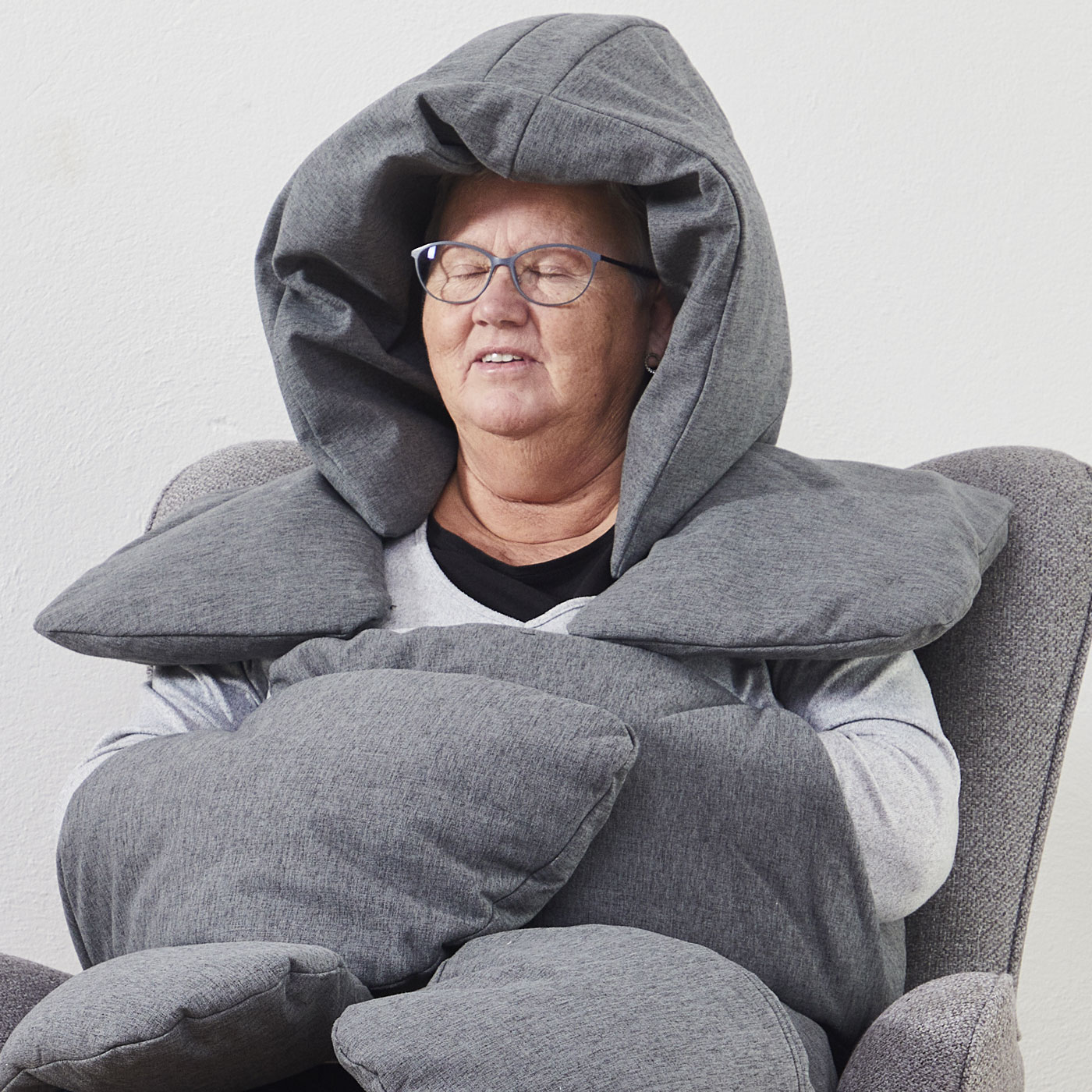

Sigurd Hartvig recommends that we pay more attention to our own sensory awareness. Everyone could use a boost in this area from time to time.
"Some are better at allowing themselves to be hugged than others. Those who are barely able to shake hands with others are often understimulated in terms of their sense of touch.
"If one is not used to receiving touch and affection as a child, one is often not very physical."
"Today, we are not as physically connected anymore – not even with our children, who regularly sit in front of computers, TVs, and with mobiles that do not stimulate the sense of touch and close physical contact. Many children use their heads, thoughts, and imagination more than their bodies and receive less touch and free movement through play than previous generations," says Sigurd Hartvig.
A school on Ærø has experimented with having a swing in the classroom. Here, those who are overactive could take a few minutes on the swing to calm down, stimulating their vestibular sense. Previously, many more children would swing and move naturally during break time.
"Due to the tendency to sit still in front of screens, it is obvious that we should train the senses and ensure a counterbalance. For example, by dancing freely and through free play. Or when we walk in the forest or park, to go off the path, onto some small branches or cones, over a tree trunk… In this way, we also stimulate the fluid in the ears, which the semicircular canal is filled with," he explains.
"The beach with sand or stones is also an excellent sensory playground. Bare feet in the sand, at the water's edge…"
"It is said that the head should ideally reach every corner of the room every day. Most children do this quite naturally when they spin around, play, and dance. It is so healthy that adults should never stop doing the same. But unfortunately, we as adults often forget to do this. These are natural movements that we must not forget," recommends Sigurd Hartvig.
When the senses are stimulated and trained to function well, neurotransmitters in the body can be more effectively transported through the nervous system.
"The more we can feel ourselves and move our bodies in a good way, the better our movement patterns will be. If we are not used to using our bodies, our joints are affected by it. They will behave differently but do become stronger when we train them."
"Especially the development of technology has contributed to removing us from the natural way of moving. Many sit down for a large part of the day, on a chair, slightly bent forward at a keyboard, and with their head directed towards the screen. We are not designed for that at all!"
"By nature, we are coded to squat or sit on the ground. Perhaps this is one of the major culprits in relation to many of the lifestyle issues we see today," he says.
"We also used to think and speak a bit more slowly. There was more time to breathe calmly and deeply along the way.
Some of us would benefit from retraining the ability to just feel, be present, and sense without being in a hurry."
"The body is in many ways affected by the actual lifestyle. If we look solely at the physical aspect, it is clear that with less stimulation of the body and senses, issues such as obesity, impaired circulation, and other lifestyle diseases also follow."
"We no longer use the body in the way it needs to be used. Movements involved in eating, going to the toilet, etc., have today become as little taxing on muscles and joints as possible. But the body needs to be kept active and used every day!"
"The benefit of using the body for basic daily movements is that senses, muscles, and joints receive a daily service check, where all parts are lubricated. If this doesn't happen, over time, everything will become understimulated and rust," adds Sigurd Hartvig.

Motor skills advisor and physical trainer Sigurd Hartvig encourages us to do something good for our senses. Training the senses is of great importance for our health – both mentally and physically," he believes.
625,00 kr. – 835,00 kr.Price range: 625,00 kr. through 835,00 kr. ekskl. moms
44.995,00 kr. ekskl. moms